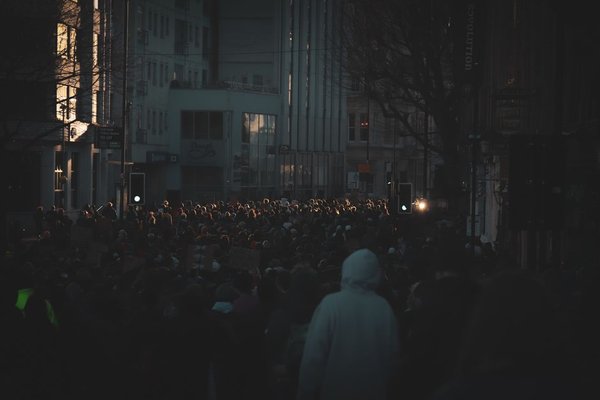
Peaceful protest is not a favour granted by the government. The principle that allows people to demonstrate in a town square also helps them organise a campaign group or join a trade union. Article 11 of the European Convention on Human Rights (ECHR) protects these activities through the rights to peaceful assembly and association.
For anyone exploring freedom of assembly in the UK, the essential question is when public authorities can interfere with a gathering, and what they must consider before doing so.
What does Article 11 protect?
Article 11 ECHR guarantees everyone the right to gather peacefully and associate for shared purposes. It expressly includes forming and joining trade unions. These protections apply to unpopular causes as well as widely supported ones; a demonstration does not lose protection merely because its message offends or inconveniences people.
Peaceful assembly can include marches, rallies, vigils and meetings. Freedom of association covers political parties, community organisations, campaign networks, voluntary groups and unions. People generally also have a right not to be compelled to join an association.
Article 11 often operates alongside Article 10, which protects freedom of expression. A march conveys a message, while the gathering itself exercises assembly rights. Together, these rights explain why protest matters in democratic life.
How does Article 11 operate under UK law?
The Human Rights Act 1998 gives effect to Convention rights, including Article 11, in domestic law. Public authorities, including police forces, must act compatibly with those rights unless primary legislation requires otherwise. Courts can examine whether interference with a protected gathering was lawful and justified.
Article 11 does not override every other law or give protesters an unrestricted entitlement to use private property. It provides a framework for assessing how legal powers are exercised. Legislation governing processions, public order and particular locations still matters.
The Convention protection extends across the UK, but detailed protest rules differ between England, Wales, Scotland and Northern Ireland. Guidance about one jurisdiction should not automatically be treated as advice for another.
What makes an assembly peaceful?
The key distinction is between participating in a peaceful gathering and engaging in violence. A noisy, critical or inconvenient demonstration is not automatically violent. Disruption alone does not settle whether Article 11 applies, although particular disruptive conduct may be restricted or criminalised.
Authorities must consider the conduct and circumstances rather than treating everyone at an event as responsible for isolated wrongdoing. Equally, Article 11 does not shield assault, threats of violence or other criminal acts merely because they occur during a protest.
When can the authorities restrict these rights?
Article 11 is a qualified right, not an absolute one. A restriction must have a basis in law, pursue a legitimate aim identified by the Convention, and be necessary and proportionate in a democratic society.
Legitimate aims include protecting public safety, preventing disorder or crime, safeguarding health, and protecting other people’s rights and freedoms. National security may also be relevant. Interference requires adequate justification, not merely administrative convenience.
Why proportionality matters
Imagine police expect a large march to block the only access route to a hospital. Changing its route may protect emergency access while preserving the demonstration’s message. A blanket ban on every protest in town would demand much stronger justification. Legality depends on the evidence, powers used and alternatives.
Public authorities may also have positive obligations to take reasonable steps to enable peaceful assemblies, even where opponents threaten disruption. That does not mean authorities must guarantee every event proceeds without difficulty.
What are the main protest rules in England and Wales?
The Public Order Act 1986 supplies much of the framework for policing marches and stationary assemblies. Organisers of many planned public processions must give advance written notice, subject to statutory exceptions and situations where notice is not reasonably practicable. There is no equivalent general advance-notice requirement for every stationary assembly.
Police may impose authorised conditions on certain protests where statutory tests are met. Conditions may address a route, location, duration or other aspects of an event. Organisers and participants should understand any conditions communicated to them, since breaching lawful conditions can have criminal consequences.
Later legislation expanded protest-related powers and offences. The Police, Crime, Sentencing and Courts Act 2022 amended policing provisions; the Public Order Act 2023 introduced offences concerning tactics such as locking on and interference with key infrastructure. The Crime and Policing Act 2026 introduced further measures, including provisions addressing repeated protests and specified conduct at demonstrations. The precise offence, commencement date and territorial extent matter in individual cases.
For practical detail about notification and conditions, a guide to police powers at protests is a useful next step.
Freedom of association goes beyond street protests
Article 11 also protects people working together over time. Residents may establish a neighbourhood campaign, workers may join a union, and individuals may organise around political or social causes. Association should normally be voluntary.
Trade unions receive explicit recognition, but that does not make every industrial action automatically lawful. Employment and trade union legislation establishes separate requirements, and restrictions must be considered in context. Workers should distinguish freedom of association from the detailed rules on industrial action.
Restrictions can also apply in particular public-service roles. Article 11 expressly permits lawful restrictions concerning members of the armed forces, police and state administration, subject to applicable human rights principles.
What should you do if a protest is restricted?
If you are organising an event, identify which nation’s rules apply, check whether notice is required and keep records of communications with police. Ask which legal power supports any proposed condition and what reasons are given. Consider whether a less restrictive arrangement could address genuine safety concerns.
If a decision appears unjustified, seek timely advice from a solicitor or civil liberties organisation. Challenges may depend on urgency and the available legal procedures. An overview of your right to peaceful protest and a guide to challenging public authority decisions can provide further context.
Frequently asked questions
Does Article 11 mean I can protest anywhere?
No. It protects peaceful assembly but does not create an unlimited right to enter private land, obstruct transport or ignore lawful restrictions. Location and relevant legislation matter.
Can police stop a peaceful protest?
Police can use statutory powers where legal thresholds are satisfied. Any interference with Article 11 rights must also be assessed for lawfulness and proportionality. Unpopularity alone is not enough.
Does freedom of association include trade unions?
Yes. Article 11 expressly protects forming and joining trade unions, although separate laws regulate employment relationships and industrial action.
Does Article 11 apply in Scotland and Northern Ireland?
Yes, the Convention right applies across the UK. However, procedures and public order legislation can differ, so local rules should be checked before organising an event.
Conclusion
Article 11 freedom of assembly and association in the UK protects more than a single march. It safeguards gathering peacefully, making collective demands and building organisations around shared interests. Understanding its limits requires looking at both the Convention’s proportionality test and domestic law. That distinction helps identify when a restriction is justified and when a fundamental freedom may have been interfered with unlawfully.